The Timeline of Jamaica
FiwiRoots takes you beyond Jamaica's beaches to explore the island's rich history, vibrant culture, and unique geography. The podcast uncovers untold stories, celebrates Jamaican traditions, and delves into what makes the nation powerful.
Episodes

Jamaica's 300-Year-Old Mystery: Who Built Colbeck Castle—Clues History Missed & The Likely Builder
Who Built Colbeck Castle—The Clues History Missed & The Likely BuilderTwo miles north of Old Harbour stands one of the strangest surviving buildings in Jamaica.Colbeck Castle is difficult to mistake for any other great house on the island. Four massive three-story towers rise from its corners. Between them run two levels of open arcades—three bays across the shorter elevations and five across
Black River, Jamaica: Echoes of a Former Glory
There was a time when Black River was one of Jamaica’s most important towns—a place of ships, warehouses, merchants, government offices, and international trade. Its river carried logwood and other goods from the interior to the sea, while wealth flowed through a system built in large part on the labor of enslaved Africans and their descendants.Then the advantages that made Black River prosper beg
The Arithmetic of Empire: How Planters Invented Jamaica's Racial Math
Every time we fill out a form or answer a census, we are asked to check a box. Black. White. Mixed. Today, our choices have been narrowed for us, forcing centuries of rich, complex heritage into broad, oversimplified categories. We have been conditioned to treat these few checkboxes as fixed truths about who we are.But the pendulum used to swing to a much darker extreme. Centuries ago, colonial of

Beyond Babylon: The Forgotten History of Rastafari
History is often written by the victors, but the true story of Rastafari was forged by those the world chose to ignore. Beyond Babylon: The Forgotten History of Rastafari peels back the layers of colonial record-keeping to explore the birth, struggle, and evolution of a movement that redefined identity, faith, and resistance.In this deep-dive episode, we move past the stereotypes to uncover the ra
The Cow Called Jamaica Hope: How a Jamaican Engineered a Better Cow for the Tropics
Jamaica is known for reggae, sprint legends, Blue Mountain coffee, and a culture that seems too large for one small island. But there is something else Jamaica gave the tropics — something far less famous, but deeply important. A cow. Not just any cow.A cow designed for heat, hillsides, ticks, poor pasture, and the daily struggle of small farmers who needed milk, income, and a way out of poverty.A
A Mother’s Legacy — A Haunting Prequel
The Narrative Series: Voices from the PastIn this episode we step into Glen Carty’s, A Mother’s Legacy, the haunting prequel to The Secret Pact. This is the story behind Silas — the man whose fate becomes the gravity around which The Secret Pact turns. He is the one others will risk everything to protect. He is the one his enemies are determined to crush. His existence defined the extremes: life a
Against All Odds: The Rise of Jamaica’s First Black Millionaire in the 1800s
Born in 1820, just 18 years before the end of enslavement, George Stiebel entered a world designed to keep him at the bottom. He was the son of a German Jewish merchant and a Black Jamaican mother—a man born into the 'middle' of a rigid colonial caste system.His journey from a ship’s carpenter to Jamaica’s first Black millionaire was not a straight line, but a path carved through the 1800s
The $3.5 Billion Secret: How the Diaspora Sustains Jamaica
History often records migration as a change of address, but for the Jamaican diaspora, leaving the island is a calculated strategy for survival and a powerful macroeconomic engine. In this episode, we explore the "Modern Era" (1990s–Present), where the movement of people has evolved into a fluid, multi-directional network of capital and culture.We dive deep into the "Circularity&quo
Port Royal’s Thames Street: The Machine That Laundered an Empire
In 1680, Port Royal wasn’t run from taverns or pirate decks. It was run from 500 yards of brick warehouses on Thames Street.While the world saw "the wickedest city on earth," a tight network of Sephardic Jewish merchants saw a counting house. They financed the privateers, absorbed the Spanish silver, and quietly transformed raw plunder into legitimate English capital.This wasn’t chaos. I
Spanish Town: The Intelligence Engine Behind Jamaica’s Fall
The invasion faltered. The Spanish fled. The colony should have collapsed into chaos.Instead, it held.Not because of soldiers or ships—but because the system survived.Long before Port Royal counted silver, Spanish Town counted information. Through ledgers, letters, and merchant correspondence, a Sephardic trading community preserved the intelligence that made the English hold on Jamaica workable.T
The Syrians & Lebanese in Jamaica
Syrian and Lebanese immigrants arrived in the 1890s as Ottoman subjects, many starting as itinerant peddlers—on foot or with a donkey, credit book in hand, along Jamaica’s rural roads. Loads became stalls, stalls became shops, and shops grew into retail and wholesale networks. Families, associations, and a hyphenated identity took root, and by the mid-20th century their surnames appear across comm
The Arrival of East Indians in Jamaica: Contracts & Crossings
Between 1845 and 1916, roughly 37,000 Indians arrived in Jamaica as indentured laborers, the first 261 docking at Old Harbour aboard the SS Blundell on May 10, 1845. Many intended to return after their contracts, but only about 38% repatriated; most settled and became the island’s largest ethnic minority. Harsh plantation conditions, shifting policies, and the stop-start promises of land or cash s
The Jews in Jamaica: From Iberia to Port Royal
Jamaica’s Jewish story begins with Sephardic exiles from Spain and Portugal who, under Spanish rule, often lived as secret Jews. After the English conquest in 1655, they could practice openly and grew into a vital mercantile community—first in Port Royal, then in Spanish Town and Kingston. Despite periods of restriction, civil rights expanded in the early 19th century, and Jewish Jamaicans helped
Thistles & Sugar: The Scots in Jamaica
Scottish migration to Jamaica gathered pace after 1655, when soldiers, merchants, and later waves of indentured workers and overseers crossed the Atlantic in search of fortune. Many found roles on sugar estates—as planters, bookkeepers, and traders—while others built shops and shipping links that tied the island to Glasgow and the Clyde. Their presence left a long trail of surnames, congregations,
Cold Betrayal: Trelawny Town Maroons Exiled to Nova Scotia, Canada
This episode recounts the devastating exile of over 500 Trelawny Town Maroons from Jamaica to Nova Scotia, Canada, following the Second Maroon War in 1796. Despite facing a betrayal of promised terms of surrender, the British government deported them to Halifax, where they arrived in July 1796 and were immediately used as a critical source of labor due to a local shortage. Accustomed to the tropic
German Settlement in Jamaica: Attempts at Shaping Freedom
When slavery ended in Jamaica, freedom didn’t come without resistance. Planters and the colonial government feared the newly freed would claim the island’s fertile highlands and build lives beyond their control. Their answer was the German Settlement Plan — a program to import hundreds of Europeans to farm, populate, and occupy Jamaica’s interior.This episode explores how those “attempts at shapin
Unpacking Jamaica's Surnames: Echoes of Past Empires & Loss of Identity
Jamaica’s surnames tell the story of a global crossroads. Though most Jamaicans are of African descent, the island’s names are largely European—especially British and Scottish. Exploring these names uncovers the complex intersections of slavery, migration, and identity that define Jamaica’s past and present.
The English Conquest of Jamaica — Commerce, Slavery & Empire
England’s decisive entry came with the 1655 conquest, bringing new laws, the Anglican Church, and a plantation economy geared to sugar and Atlantic trade. Port Royal boomed as a privateering and mercantile hub until the 1692 earthquake shifted power toward Kingston and Spanish Town. English planters, merchants, and officials shaped the island’s institutions and profited from enslaved labor; after
The Irish in Jamaica: Settlement & Legacy
Irish migration to Jamaica grew in the 1600s, driven by war, displacement, and indenture—especially after the Cromwellian campaigns and the English conquest of 1655. Some arrived as soldiers and overseers; others as bound laborers who later became artisans, shopkeepers, and small farmers. Their presence threaded through plantation life—entangled with slavery’s profits—while Catholic parishes, surn
Jamaica under the Spanish
Spain’s Jamaica began with Columbus in 1494 and formal colonization by 1509. Early capitals—Sevilla la Nueva (near St Ann’s Bay) and later St Jago de la Vega (Spanish Town)—anchored a small colony built on encomienda labor and the rapid collapse of the Taíno population, followed by the importation of enslaved Africans. Ranching outpaced sugar, missions dotted the interior, and maroon communities f
Did one of the Industrial Revolution’s biggest breakthroughs actually start in Jamaica?
Rethinking the Industrial RevolutionFor over two centuries, Britain has celebrated the Cort Process as a hallmark of English innovation — the iron-refining technique that powered railways, bridges, and the rise of empire. But new research is challenging that story.In 2023, historian Dr. Jenny Bulstrode published groundbreaking evidence suggesting that a group of 76 highly skilled Black ironworkers
The First Maroon War: Promises, Punishments, and Divide-and-Rule
Step into 18th-century Jamaica, where fragile treaties, land concessions, and calculated strategies of divide-and-rule shaped a volatile peace between Britain and the Maroons. This episode unpacks the First Maroon War and the unequal treaties that followed — agreements designed not only to end open conflict, but to fracture alliances and entrench colonial control.
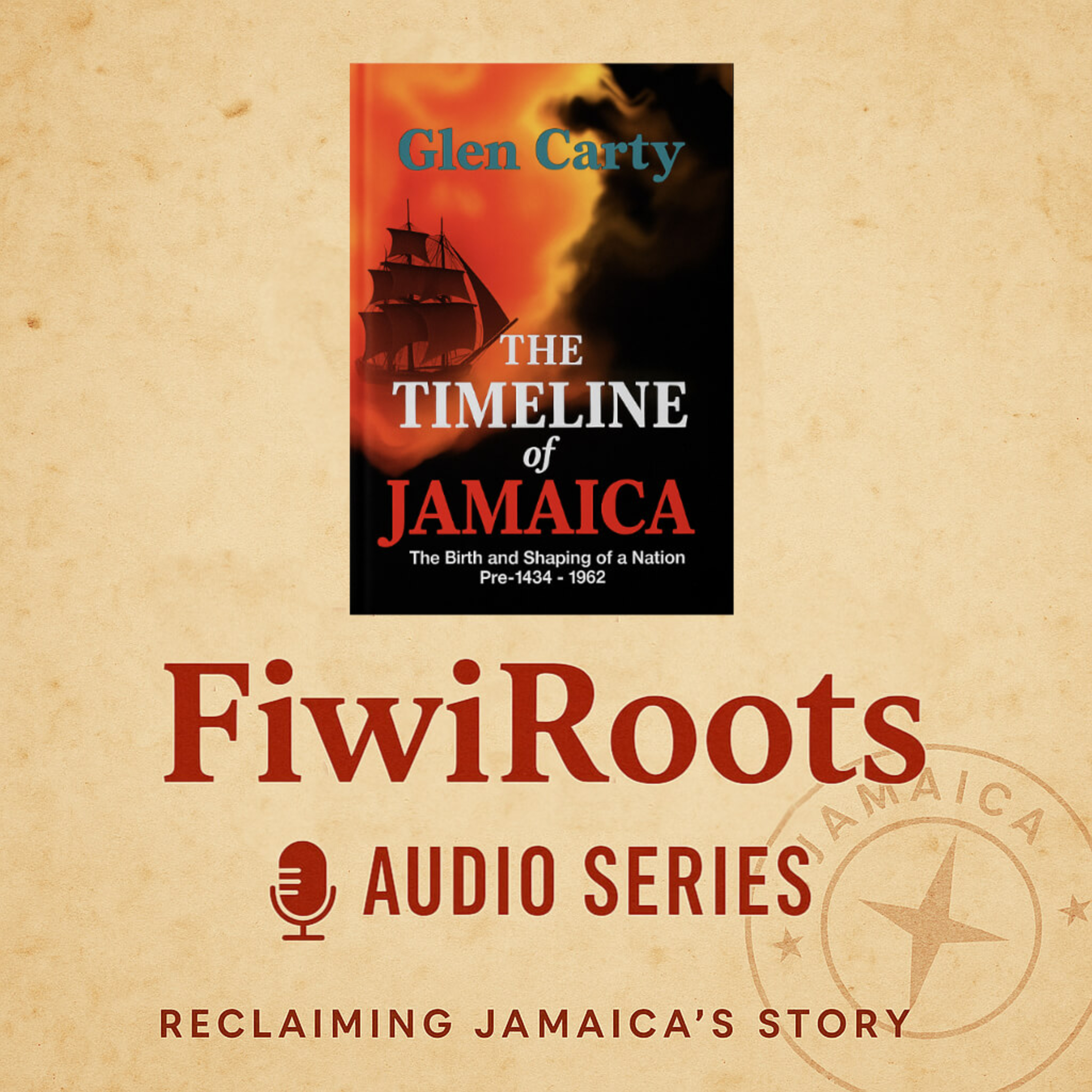
Origins & Life of the Taíno — Jamaica’s Original People
For centuries, records declared the Taíno “extinct”—a paper verdict shaped by epidemic, forced labor, and time. Yet families, language, and lifeways endured. This episode follows that living return. For the human line behind the history, the historical novel The Secret Pact—set in Maroon-era Jamaica—threads those themes through a fast-paced tale of rebellion, suspense, and intrigue.
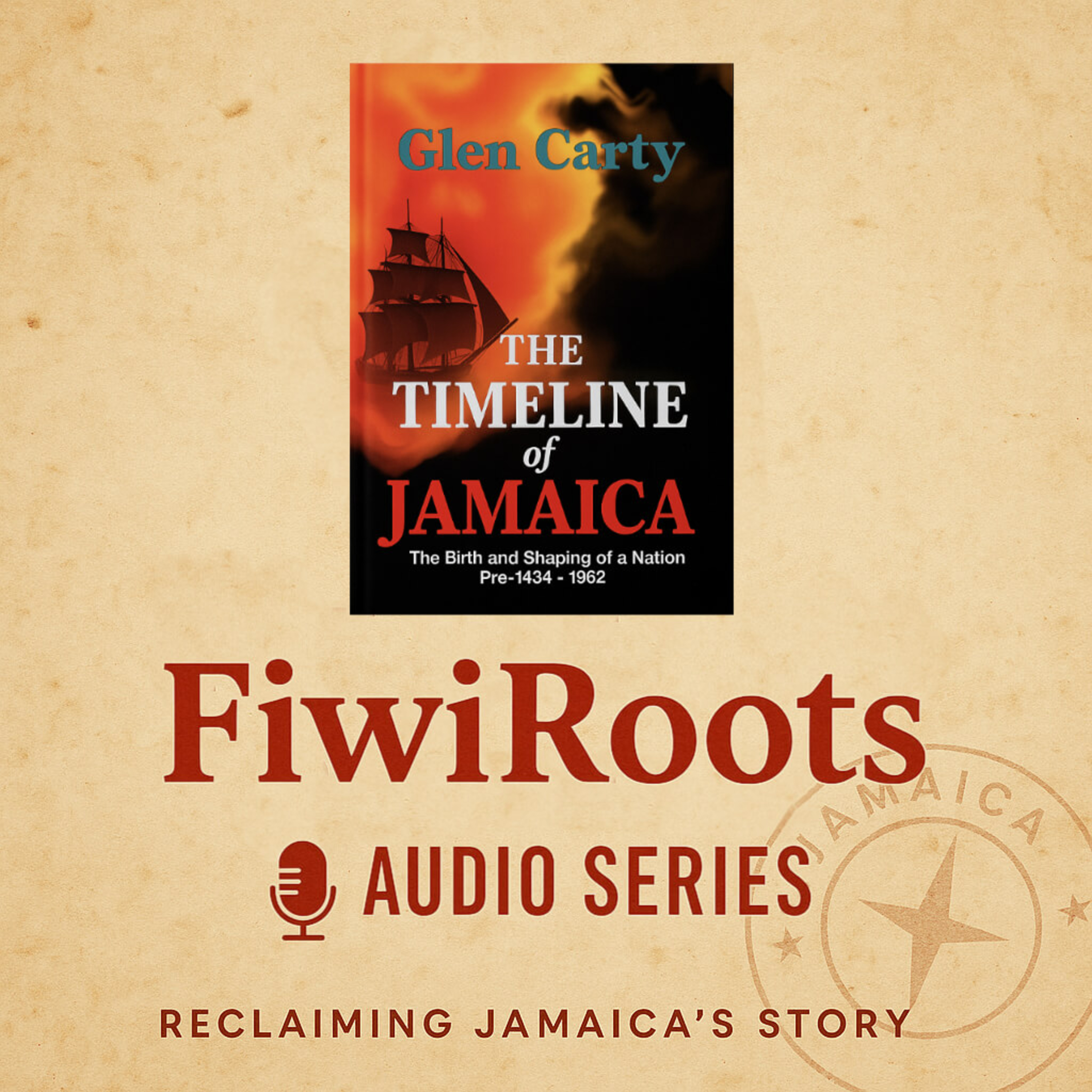
Africans in Jamaica, Chains, Crossroads & Freedom
From 1655 to 1809, over a million Africans were transported to Jamaica, making the island one of the largest destinations in the transatlantic slave trade. Drawn mainly from West and Central Africa, they endured brutal plantation conditions, resisted through rebellion and maroon communities, and laid the foundations of Jamaica’s culture and identity. Emancipation in 1838 ended slavery, but their l
Arrival of the Chinese in Jamaica
The Chinese presence in Jamaica began in 1854 with the arrival of the first two groups of indentured laborers. Brought to the island after the abolition of slavery, they were initially deployed on sugar plantations. Subsequent waves, drawing primarily from southern China, arrived in the years that followed. Though conditions were challenging, the community gradually diversified, shifting from fiel
Mary Seacole, Jamaica's Forgotten Doctress
Mary Seacole was a Jamaican-born nurse and businesswoman who faced racial and gender discrimination yet persevered to make an extraordinary contribution during the Crimean War. Refused official nursing roles, including with Florence Nightingale’s team, she financed her own voyage to Crimea and established the British Hotel near the front lines. More than just a place for food and rest, the British
Jamaicans Who Rebuilt the UK After World War II — Then Were Forgotten
In 1948, hundreds of Jamaicans and other Caribbean men and women sailed to Britain, promised citizenship and invited to help rebuild after the war. Driven by hope for a better life and greater opportunities for their children, they became the Windrush Generation — working, paying taxes, raising families, and building new lives. Yet decades later, many faced a shocking injustice. Branded as illegal
The Morant Bay Rebellion and the Aftershock That Divided the British Empire
In a special deep dive, we explore the shocking story behind a key chapter from the book 'The Timeline of Jamaica' by Glen Carty. The 1865 Morant Bay Rebellion in Jamaica sent a bloody aftershock across the Atlantic, igniting a firestorm of public debate that drew in celebrated British figures like Charles Darwin and Charles Dickens. We go beyond the history to reveal how this remote uprising forc